

The Cage has until 25 August to appeal the noise abatement notice served on 5 August. What the notice actually says, and why its music licence could not stop it.
Live music has stopped at The Cage in Reigate after Reigate & Banstead Borough Council served the bar with a noise abatement notice on 5 August. The venue cancelled its programme the next day, and a petition asking the council and the business to find a workable compromise had 10,488 verified signatures when we checked it on Thursday 13 August (petition).
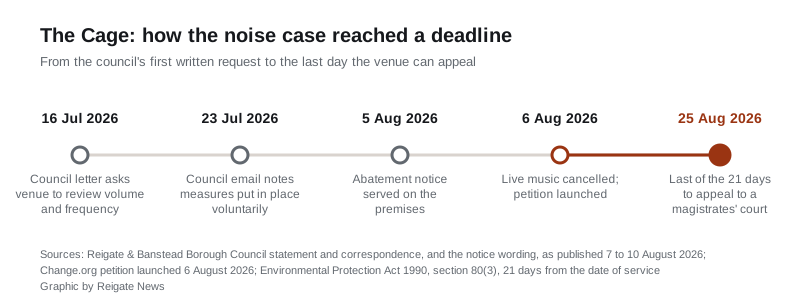
The date that now matters most has had almost no attention. Section 80(3) of the Environmental Protection Act 1990 gives anyone served with an abatement notice 21 days, beginning with the day they were served, to appeal it to a magistrates’ court (section 80). Counting from 5 August, that window runs out at the end of Tuesday 25 August 2026. Once it closes, the notice stands as served, whatever happens to the petition.
What the notice actually requires
This is the part most worth reading closely, because the notice does not say what a lot of people think it says. Its operative wording, as published on 7 August, is that “no statutory noise nuisance shall be caused to the occupiers of any residential premises by music or entertainment noise, whether live or recorded, amplified or unamplified, or by the use of any amplification or sound reproduction equipment”.
There is no ban on live music in that sentence, and no curfew, decibel limit or event cap either. It prohibits an outcome. The council put the same point in its own words: “The notice does not prohibit live music. This has been the decision of the business,” a spokesperson said, adding that it “requires the premises to ensure that, when events take place, they are appropriately managed and controlled so that they do not cause a statutory noise nuisance to neighbouring residents”, and that officers remained available to discuss what compliance could look like (statement to trade title the Morning Advertiser, 10 August).
That open wording cuts both ways. It leaves room to keep putting bands on, which is what the council says it intends. It also leaves the venue carrying the risk of judging, in advance and on its own, what will later be held to be a nuisance, with a criminal offence at the end of a wrong guess. The business took the safe reading: “We are sorry to announce that, following the service of a Noise Abatement Notice by the Environmental Services department of Reigate & Banstead council, we have to cancel all live music at the Cage until further notice.”
Pilgrim Brewery, the Reigate brewery that bought The Cage in 2024, has been blunt about the stakes. Co-owner Adrian Rothera said: “It is an absolute certainty that without live music The Cage will not survive as a hospitality venue; it is only the busy summer months that sustain the business over the winter months.”
Why the venue’s music licence could not protect it
The Cage says it is licensed to play music outdoors in its courtyard until 11pm, seven days a week, and that in practice it ran bands or DJs about once on a summer weekend and rarely midweek. Plenty of people have asked how a venue doing what its licence permits can be stopped anyway. The answer is that the two systems are separate, and one of them was deliberately switched off by Parliament.
Under section 177A of the Licensing Act 2003, inserted by the Live Music Act 2012, where premises are licensed to sell alcohol for consumption on the premises and are open, any licence condition “which relates to live music, recorded music or both does not have effect” while amplified music takes place between 8am and 11pm before an audience of no more than 500 people (section 177A). Conditions of that kind can only be brought back to life on a review of the premises licence, which is a separate legal process the council has not used here.
So the licensing route to controlling daytime and evening live music had been suspended by statute. What remained was the statutory nuisance regime, and that is the door the council went through.
Why a complaint from one household was enough
Section 79(1) of the same 1990 Act makes “noise emitted from premises so as to be prejudicial to health or a nuisance” a statutory nuisance, and puts a duty on every council to inspect its area and, “where a complaint of a statutory nuisance is made to it by a person living within its area, to take such steps as are reasonably practicable to investigate the complaint” (section 79). Nothing in the Act sets a minimum number of complainants. One household triggers the duty to investigate.
What follows is not discretionary either. Section 80(1) says that where a council is satisfied a statutory nuisance exists, or is likely to occur or recur, it “shall serve” an abatement notice. Officers reach a judgment; after that the notice is a legal consequence, not a choice.
How that judgment gets made is set out on the council’s own noise pages. To be a statutory nuisance, noise “must be considered to be unreasonable to the ‘average person’” and be more than an annoyance, and, in a line worth quoting to anyone arguing either side of this, “a sound being audible in your home does not automatically make it a statutory nuisance”. Officers weigh the time the noise happens, its duration, its frequency and pitch, the type of noise, and whether there is social acceptance or value, giving bonfire night as the example (information on noise nuisance).
There was a run-up. Correspondence published on 7 August shows the council wrote to the venue on 16 July asking that it “review the volume of the music and frequency of events to prevent any future potential nuisance arising”, and emailed again on 23 July saying “it is appreciated that these measures have been implemented voluntarily to try and minimise the impact on nearby residents”. The notice followed on 5 August. The council has said its investigation found the music clearly audible inside the complainant’s home and materially interfering with the reasonable use and enjoyment of it, and that letters, email and a site meeting had not produced sufficient improvement. We are not naming or identifying the household that complained.
What happens next
Three things can happen between now and the autumn, and only one of them has a fixed date.
- An appeal. The venue can ask a magistrates’ court to quash or vary the notice, within 21 days of service. On the council’s stated service date of 5 August, the last day is 25 August 2026. A court can strike the notice out, or rewrite it into something more workable, for example with specified hours, sound limits or management steps rather than an open prohibition.
- Negotiated compliance. The council says officers are available to agree what compliance looks like. In practice that usually means agreed finishing times, a sound limiter, moving amplification indoors or away from the boundary, and a written noise management plan. None of that needs a court.
- A licence review. If matters escalate, any person, including a resident or the council itself, can apply for a review of the premises licence under the Licensing Act 2003, which is the one route that can reimpose conditions on live music. Nobody has done that so far.
Breaching an abatement notice without reasonable excuse is a criminal offence under section 80(4). The council’s own guidance is that a person responsible “could face an unlimited fine if convicted in the magistrate’s court”. That penalty exposure is the reason a business reads an open-ended notice cautiously, and it is the strongest argument for getting the wording pinned down, by agreement or by a court, rather than left vague.
What it means for you
If you had tickets or were planning a night out. Live music at The Cage is off until further notice, and that is the venue’s decision, not a legal ban. Check with the venue before travelling. Reigate’s other music nights and venues are unaffected; our things to do in Reigate page lists what else is on, and parking in Reigate covers evening charges and the town centre car parks if you are coming in.
If you want to have a say. The petition is the visible route, and at more than 10,000 signatures it has already made the point that this matters locally. It has no legal effect on the notice. If you want to put a view to the people who decide, the council’s licensing team takes representations at licensing@reigate-banstead.gov.uk, and your borough councillors can be contacted through the council’s councillor pages.
If you live near a venue, or run one. The same law works both ways. As a resident, one complaint is enough to oblige the council to investigate, and diary sheets or recordings are the evidence officers ask for. As a business, the practical lesson from this case is that a music licence is not a shield after the Live Music Act, that voluntary measures are worth documenting, and that the 21-day appeal clock starts the day a notice lands, not the day you finish taking advice.
One caution about the numbers. Petition counts move by the hour. The 10,488 figure is what the petition showed on 13 August, and it will be higher by the time you read this.
Sources
- Change.org, Save Live Music at The Cage, started 6 August 2026 by Kelly Smith; signature count checked 13 August 2026
- Environmental Protection Act 1990, section 79 (statutory nuisance, duty to investigate) and section 80 (abatement notice, 21-day appeal, offence)
- Licensing Act 2003, section 177A (live music condition disapplication, 8am to 11pm, audience of 500)
- Reigate & Banstead Borough Council, information on noise nuisance and statutory nuisance
- Council statement and Pilgrim Brewery comment as published by the Morning Advertiser, 10 August 2026; notice wording and council correspondence of 16 and 23 July as published by East Surrey News, 7 August 2026
- Reigate Summer Festival venues (the Cage Yard Stage; Pilgrim Brewery’s 2024 purchase of the venue)
Checked against the sources above on 13 August 2026. Dates and legal positions change; confirm the current position with the council or the venue.
Have your say