

About 57% of Reigate and Banstead homes are in council tax bands A to D, the ones due £100 from January 2027. Nationally it is 81%. Who gets it and how.
Only about 57% of homes in Reigate and Banstead are in the council tax bands that qualify for the £100 Household Energy Payment announced in Wednesday’s Budget. Across England the figure is 81%.
The payment goes to households in bands A to D in England, from January 2027, the government says. The borough has 36,890 homes in those bands, out of 64,930. That leaves 28,040 homes in bands E to H, which get nothing from the main scheme.
The band counts come from the Valuation Office Agency’s council tax stock of properties, at 31 March 2025. The payment details are from the government’s own Budget explainer on energy bills.
Who gets the £100
The government says a household is eligible if it:
- lives in England
- is liable for council tax on the property
- lives there as its main home
- is in band A, B, C or D
Most households exempt from council tax will also qualify, it says, with full rules “to be published in due course”. Second homes, empty properties and households where the occupier is not responsible for council tax are not eligible.
Up to 20 million households in England will qualify, the government estimates.
How it is paid
- If you pay council tax by direct debit, you do not need to do anything. The £100 goes straight into your bank account.
- If you pay another way, the council will invite you to apply.
The government warns that nobody other than your council should contact you about claiming it. If a message asks for your details and you are unsure, check with the council first.
Reigate and Banstead Borough Council said on Wednesday it was “awaiting further information from the government about how the scheme will operate”. It will tell residents more once details are available, its statement says.
How Reigate and Banstead compares
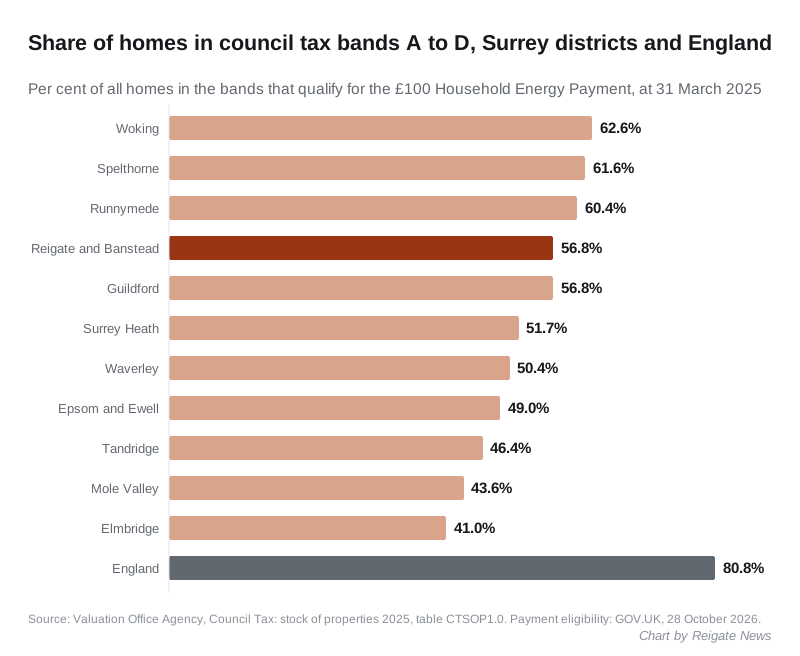
Surrey’s homes sit higher up the bands than England’s as a whole. Across the county, 52.8% of homes are in bands A to D.
Reigate and Banstead is in the middle of the Surrey table, at 56.8%. Woking has the highest share, 62.6%, and Elmbridge the lowest, 41.0%.
| Band | Homes in Reigate and Banstead | Qualifies |
|---|---|---|
| A | 1,230 | Yes |
| B | 4,270 | Yes |
| C | 13,130 | Yes |
| D | 18,260 | Yes |
| E | 11,660 | No |
| F | 7,700 | No |
| G | 7,540 | No |
| H | 1,140 | No |
| All | 64,930 |
These are counts of homes, not of eligible households. Some band A to D homes will be empty or second homes, so the number of payments will be lower.
If you are in band E or above
The government is giving councils an extra £100 million in England for discretionary help to households who need support but are not in bands A to D. Each council will set its own rules for who qualifies and publish them on its website once arrangements are in place.
Households on means-tested benefits may also qualify for the £150 Warm Home Discount, the government says. Eligibility is on GOV.UK.
What it means for you
- Check your band. It is printed next to “Property Band” at the top of your council tax bill. You can also look it up on GOV.UK’s Check your Council Tax band service. What each band pays in the borough is on our council tax bands page.
- Paying by direct debit in bands A to D? You should not need to do anything.
- Paying by cash, card or standing order? Watch for a letter from Reigate and Banstead Borough Council. Do not respond to texts or emails asking you to “claim” the £100 unless you are sure they are from the council.
- In band E or above and struggling? Look out for the council’s discretionary scheme. No local rules have been published yet.
Have your say