
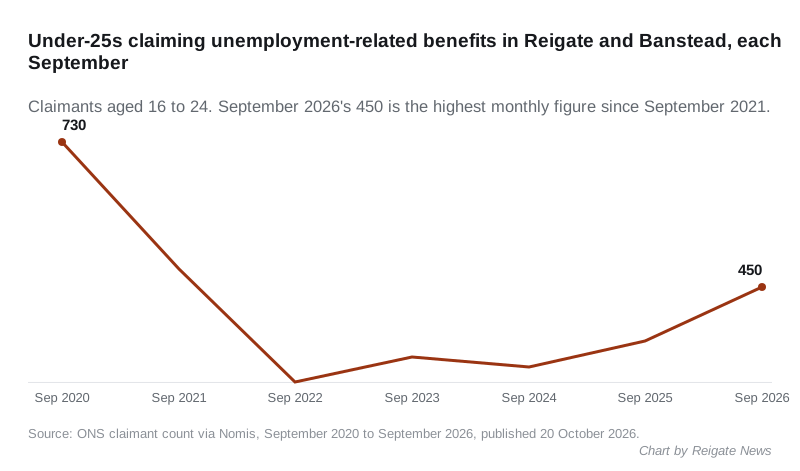
450 under-25s in Reigate & Banstead claimed in September, up 30% in a year and the most since 2021. The overall count eased to 2,175, still up 9% on a year.
450 people aged 16 to 24 in Reigate & Banstead were claiming unemployment-related benefits in September 2026. That is the highest monthly figure for the age group since September 2021, when the borough was still coming out of the pandemic.
It is 105 more than a year earlier, a rise of 30.4%. Young people now make up about one in five claimants in the borough.
The figures come from the ONS claimant count, published through Nomis on 20 October.
The overall count eased slightly
Across all ages, 2,175 people in the borough were claiming in September. That is 2.2% of residents aged 16 to 64.
It is 10 fewer than in August. A year earlier, in September 2025, the count was 1,995, so it is up 180, or 9.0%.
August’s figure has also been revised. We reported 2,215 when it was first published. ONS now puts August at 2,185.
The count has sat between 2,130 and 2,185 every month since February. The difference this autumn is in who is claiming.
Young people account for most of the rise
Of the 180 extra claimants on a year ago, 105 are under 25. The middle age group barely moved.
| Age band | September 2025 | September 2026 | Change |
|---|---|---|---|
| 16 to 24 | 345 | 450 | +105, up 30.4% |
| 25 to 49 | 1,170 | 1,180 | +10, up 0.9% |
| 50 and over | 475 | 550 | +75, up 15.8% |
The under-25 count has climbed fairly steadily for a year. It was 355 last October, reached 400 in March and reached 425 in August before September’s jump of 25.
Compare the same age groups across Surrey and the UK:
| Age band | Reigate & Banstead | Surrey | United Kingdom |
|---|---|---|---|
| 16 to 24 | up 30.4% | up 19.8% | up 10.6% |
| 25 to 49 | up 0.9% | up 2.0% | down 0.6% |
| 50 and over | up 15.8% | up 11.7% | up 4.8% |
Claims among the borough’s under-25s are rising half as fast again as the county’s, and almost three times as fast as the UK’s. The over-50s are rising faster than Surrey too, though the gap is narrower than in August, when it was 24.2% against 13.3%.
The data cannot tell us why. The claimant count records how many people claim, not which employer they left or why.
Second highest in Surrey
Among Surrey’s 11 districts, only Spelthorne has more claimants:
- Spelthorne: 2,425, 3.6% of 16 to 64s
- Reigate and Banstead: 2,175, 2.2%
- Elmbridge: 2,155, 2.5%
- Guildford: 1,960, 2.0%
- Woking: 1,890, 2.8%
As a share of working-age residents, the borough’s 2.2% is below the Surrey rate of 2.4% and well below the UK’s 3.9%. Its size, not its rate, puts it near the top of the list.
Over the year, the count rose fastest in Runnymede (up 12.6%), Elmbridge (9.9%) and Woking (9.6%). Reigate & Banstead was fourth, at 9.0%. Tandridge rose least, up 1.9%. Surrey as a whole was up 7.4%, and the UK 2.8%.
What it means for you
If you are under 25 and out of work, you are in the group that has grown fastest here, by a distance. Our local jobs board carries vacancies placed by employers in the borough.
If you are over 50, claims in your age group are still up 15.8% on a year. The government’s free Midlife MOT is designed for people in their 50s and 60s reviewing work, skills and money.
If you claim Universal Credit and are looking for more work, you may be counted here even if you have a job. The ONS says plainly that the measure “does not attempt to measure unemployment”. Some Universal Credit claimants on low earnings are required to look for more work, and they are included.
If money is tight, the council’s council tax support scheme is changing from April 2027. Our report on the East Surrey consultation sets out the proposals; comments close on 3 December.
Borough figures are rounded to the nearest five, so age bands may not add up exactly to the total, and small monthly moves are within the noise. The October figures are due from ONS in mid November.
Sources
- Office for National Statistics, claimant count by age, Nomis dataset NM_162_1, September 2020 to September 2026, published 20 October 2026 (the borough, Surrey and UK counts by age band, the revised August figure, and the 11 Surrey districts)
- Claimant count quality and methodology information, Office for National Statistics, for what the measure covers
Have your say