
The borough's bin lorries cut the fleet's carbon by 64% in a year on vegetable oil fuel. Councillors decide on 19 November whether to keep it, at extra cost.
Reigate and Banstead’s bin lorries are set to keep running on vegetable oil fuel for another two years. The council’s Executive is asked on Thursday 19 November to award a new fuel contract to Certas UK Ltd.
The contract report covers two fuels over 24 months:
- an estimated 280,000 litres a year of hydrotreated vegetable oil (HVO) for the refuse lorries
- an estimated 130,000 litres a year of diesel for the rest of the fleet
The council runs about 123 vehicles in all, the report says. They include the waste and recycling, parking, street cleaning, transport and greenspaces fleets. Only vehicles that can take HVO use it.
What the switch has saved
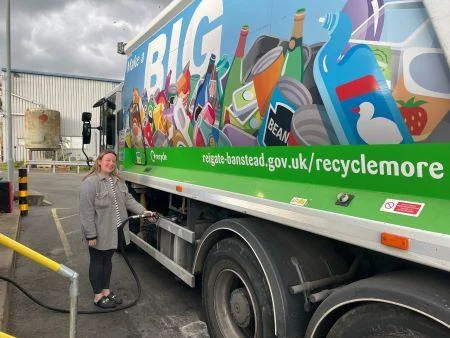
The council took its first delivery of HVO in September 2025. It said then that its 28 waste collection vehicles could run on it without any conversion. HVO is a biofuel made from waste products such as used cooking oil.
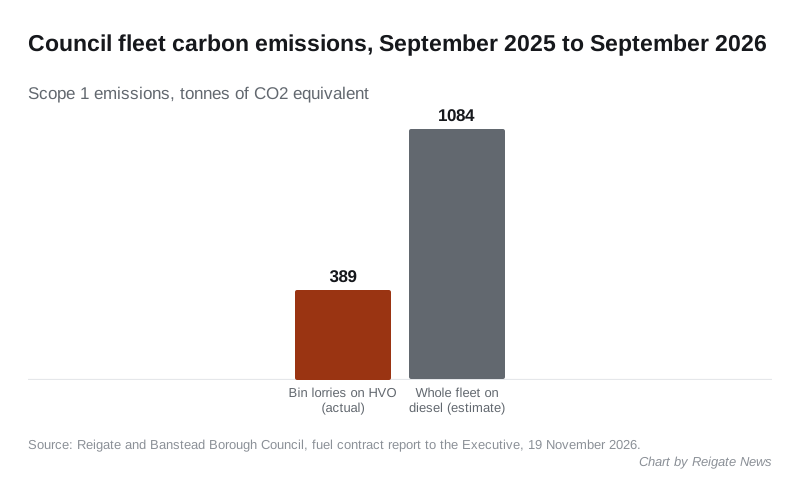
The first full year of figures is now in. Between September 2025 and September 2026 the fleet’s direct (Scope 1) emissions were 389 tonnes of carbon dioxide equivalent. Had every vehicle run on diesel, the report estimates the figure would have been 1,084 tonnes.
That is about 695 tonnes avoided, a cut of around 64%. The council had forecast a saving of around 500 tonnes a year when it made the switch.
The report calls this “the only significant carbon reduction” in the council’s footprint since its 2019/20 baseline. The council’s target is net zero for its own Scope 1 and 2 emissions by 2030.
HVO also burns cleaner on residential streets, the report says. Particulate matter is around 33% lower than diesel and nitrogen oxides around 8% lower. The report points out that the refuse lorries are likely to be the only HGVs that regularly drive into many residential roads.
What it costs
Keeping the lorries on HVO costs more than going back to diesel. These are the report’s estimates for a year:
| Option | HVO | Diesel | Total a year |
|---|---|---|---|
| Recommended: HVO for bin lorries, diesel for the rest | £594,000 | £166,000 | £760,000 |
| All 410,000 litres as diesel | none | £490,000 | £490,000 |
The fleet fuel budget for 2026/27 is £719,000. The recommended option needs an extra £44,000 a year, or about £1.52 million over the two years. Going all-diesel would come in £229,000 a year under budget.
On those figures, staying on HVO costs about £270,000 a year more than diesel. The report sets that against the government’s own carbon values. At the Green Book’s high value for 2030, £442 a tonne, it says running the lorries on diesel would equal over £316,000 a year in costs to society.
The report also warns that switching back would risk “reputational damage”, because the council publicised the move to HVO.
How the supplier was chosen
Seven suppliers on a national fuels framework were invited to bid in June 2026. Two bid to supply HVO and three bid for diesel. Bids were judged entirely on price, with pass or fail checks on quality.
Certas UK Ltd, the council’s current supplier, came top on both. Its margins are in a confidential annex.
Every HVO bidder had to confirm its fuel meets the EN15940 standard and contains no virgin palm oil.
Could the lorries go back to diesel?
Yes. The report warns that demand for HVO is forecast to rise in 2028, which could push prices up and squeeze supply. If that happens, the Head of Neighbourhood Services and the Chief Finance Officer can decide with the Executive Member to switch the lorries back to diesel.
What it means for you
- Your bin collections do not change. This is a decision about what goes in the tank, not about rounds or days. Your collection day stays the same.
- The decision is public. The Executive meets at 7.30pm on Thursday 19 November in the New Council Chamber at Reigate Town Hall. The agenda has a link to the webcast.
Have your say