
13 of the 20 Reigate and Banstead councillors who answered a council survey faced abuse or intimidation in the past year. Seven say it is getting worse.
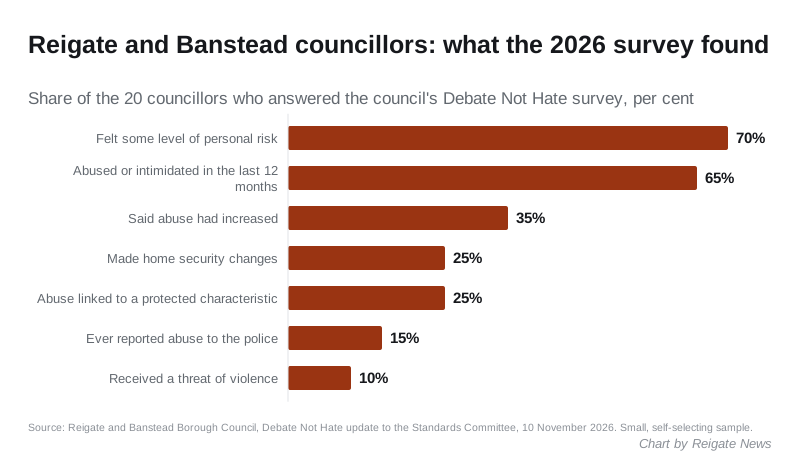
Thirteen of the 20 Reigate and Banstead councillors who answered a council survey this year said they had faced abuse or intimidation in the previous 12 months. That is 65%, up from 59% a year earlier.
The results are in a report to the council’s Standards Committee, which meets on Tuesday 10 November. It tracks the council’s progress on the Local Government Association’s Debate Not Hate campaign, which full council adopted unanimously in September 2024.
What councillors said
The 2026 survey had 20 responses, against 22 in 2025. The report finds:
| Measure | 2025 | 2026 |
|---|---|---|
| Felt some level of personal risk | 64% (14 of 22) | 70% (14 of 20) |
| Abused or intimidated in the last 12 months | 59% (13 of 22) | 65% (13 of 20) |
| Abused frequently | 5% (1 of 22) | 5% (1 of 20) |
| Said abuse had increased | 14% (3 of 22) | 35% (7 of 20) |
| Received a threat of violence | 18% (4 of 22) | 10% (2 of 20) |
| Abuse linked to a protected characteristic | 9% (2 of 22) | 25% (5 of 20) |
| Ever reported abuse to the police | 9% (2 of 22) | 15% (3 of 20) |
| Made home security changes | 27% (6 of 22) | 25% (5 of 20) |
No councillor in either year said they felt at risk frequently.
Better than the national picture, but heading the same way
On most measures Reigate and Banstead sits below the LGA’s national figures for England and Wales. In 2026, 74% of councillors nationally reported abuse or intimidation, against 65% here. A quarter nationally reported a threat of violence, against 10% here.
Two local figures stand out. Reports of abuse linked to a protected characteristic, such as race, religion, sex or disability, rose from two councillors to five. That is above the national figure of 13%. And the share saying abuse is getting worse more than doubled, from 14% to 35%. Nationally it rose from 46% to 55%.
The report is careful about what the numbers can show. The samples are small and self-selecting, so “a change involving only a small number of respondents can therefore produce a noticeable percentage movement”. It says the five councillors reporting protected-characteristic abuse “should not be treated as a prevalence estimate”.
Its overall reading: the local picture “appears less severe than the closest national benchmark”, but “intimidation and abuse appears to have increased during the past year”.
The reporting form nobody used
The council introduced an incident reporting form for councillors in 2025-26, included in their weekly bulletin. No incidents have been reported through it.
The report says the gap between that and the survey results “warrants checking whether Members understand what to report, how to report it and what response they can expect”.
Other measures in place, according to the report:
- Several councillors have had their home addresses withheld from the published register of interests on safety grounds.
- Councillors have had free, confidential wellbeing support, around the clock, since September 2025.
- A lone-working risk assessment for councillors was approved in May 2026. A check-in and check-out system is still to be developed.
- The council’s insurers have confirmed councillors are covered for personal accident and assault while on council business.
- The council works with Surrey Police’s Operation Ford team on security briefings for councillors and election candidates.
The council’s own campaign reached few people. Over 2025 to 2026 it published 24 social media posts, which drew 72 link clicks.
What it means for you
- Criticism is not abuse. The report says a zero-tolerance approach should preserve “legitimate criticism, robust scrutiny and democratic disagreement”. You can still challenge your councillor as hard as you like.
- Complaints about a councillor’s conduct go through the council’s standards process. Our report on last year’s complaints shows how many were made and what happened to them.
- The committee meets on Tuesday 10 November at 7pm. Papers are on the council’s website.
Have your say